

Race for Reform
Human Rights Abuses Shadow Countdown to 2008 Beijing Games
“The starting gun has been fired on the assessment of China’s commitment to rights at home and abroad. Just as Chinese citizens will be rooting for their athletes to win medals, we are rooting for the Chinese government to move up in the league tables on rights protection.”

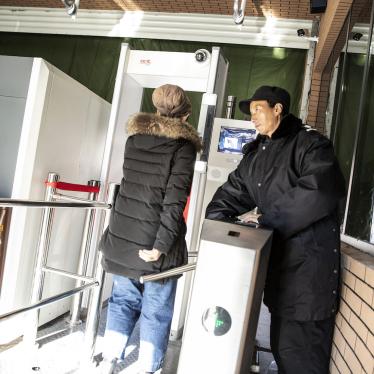
Ahead of the August 8, 2008 opening ceremonies for the Beijing Olympics, the Chinese government has shown little substantive progress in addressing long-standing human rights concerns. Instead, apparently more worried about political stability, Beijing is tightening its grip on domestic human rights defenders, grassroots activists and media to choke off any possible expressions of dissent ahead of the Games.

China has a well-documented history of serious human rights abuses, including widespread torture, censorship of the media and internet, controls on religious freedom, and repression of ethnic minorities in Tibet and Xinjiang. China continues to lead the world in executions. The government classifies the number of people executed as a state secret, but it is believed that China executes many more people than the rest of the world combined each year. Most trials are deeply flawed, as the accused often do not have access to adequate defense counsel, trials are usually closed to the public, evidence is often obtained through torture, and the appellate process lacks needed safeguards. China’s courts lack independence, as they remain controlled by the government and ruling Chinese Communist Party.

But the staging of the Olympics is exacerbating problems of forced evictions, migrant labor rights abuses, and the use of house arrests to silence political opponents. The government is continuing its crackdown on lawyers, human rights defenders and activists who dedicate themselves to rule of law and the exposure of rights abuses. Fear of citizen activism has led to government obstruction of local activists and grassroots organizations working to stem China’s HIV/AIDS epidemic. Fears of harm to China’s national image have even led Chinese officials to stop prominent activists from leaving the country.

As the one-year countdown to the Olympics began in August 2007, the starting gun was fired on the assessment of China’s commitment to rights at home and abroad.

Major areas for human rights reform in the Olympic run-up:

  • Forced evictions and school closures. The construction of facilities for the 2008 Olympic Games in Beijing has involved forced evictions of thousands of citizens in and around Beijing, often without adequate compensation or access to new housing. The pre-Olympic “clean-up” of Beijing has resulted in the closure of dozens of officially unregistered schools for the children of migrant workers.
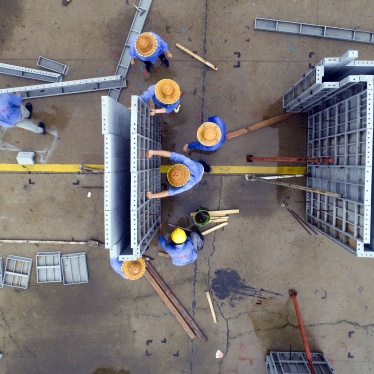
  • Labor rights abuses. Thousands of migrant workers employed on Olympic and other construction sites across Beijing do not receive legally mandated pay and benefits including labor insurance and days off, and are often compelled to do dangerous work without adequate safeguards.
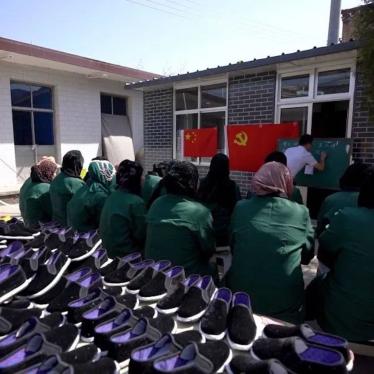
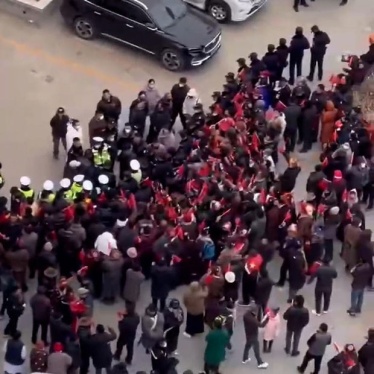
  • Repression of ethnic minorities. China continues to use the “war on terrorism” to justify policies to eradicate the “three evil forces” – terrorism, separatism, and religious extremism – allegedly prevalent among Uighurs, a Turkic-speaking Muslim population in China’s Xinjiang Uighur Autonomous Region. Uighurs who express “separatist” tendencies are routinely sentenced to quick, secret and summary trials, sometimes accompanied by mass sentencing rallies. The death penalty is common. In Tibet, Chinese authorities still view the Dalai Lama, in exile in India since 1959, as central to the effort to separate Tibet from China and view Tibetan Buddhist belief as supportive of these efforts. Suspected “separatists,” many of whom come from monasteries and nunneries, are routinely imprisoned.
  • Controls on religious freedom. China does not recognize freedom of religion outside the state-controlled system in which all congregations, mosques, temples, churches and monasteries must register. The government also curtails religious freedom by designating and repressing some groups as “cults,” such as the Falungong.
  • The death penalty and executions. The government does not publicize figures for the death penalty, but it is mandated for no fewer than 68 crimes. Though the exact number is a state secret, it is estimated that as many as 10,000 executions are carried out each year.
  • HIV/AIDS rights advocacy obstruction. Measures to address China’s HIV/AIDS crisis are hampered as local officials and security forces continue to obstruct efforts by activists and grassroots organizations to contribute to prevention and education efforts and to organize care-giving.
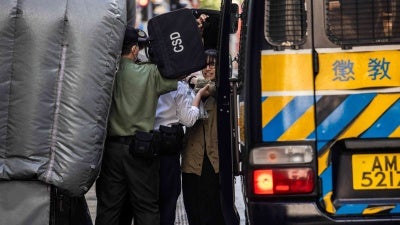
  • Use of house arrest system. Numerous human rights defenders and government critics have been harassed, detained and subject to house arrest. If today’s pattern holds, a pre-Olympic clampdown in the weeks and months before the Games is likely.
  • Ties with rights violators. China’s close relations with countries linked to severe, ongoing human rights violations are also a serious source of concern. China maintains relations with and provides aid to regimes including Sudan, the site of egregious human rights violations in Darfur, and Burma, whose military junta violently suppresses civilians. China has also not ratified the International Covenant on Political and Civil Rights, which it signed in 1998.